
Research
Research Compounds
Identity, purity, quantity and targeted safety checks.
Choose from analytical, quality, microbiology and characterisation services for research compounds, raw materials and finished products.
Testing scope
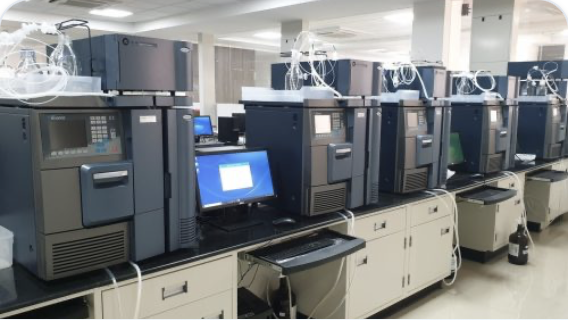
Identity, purity, quantity and targeted safety checks.
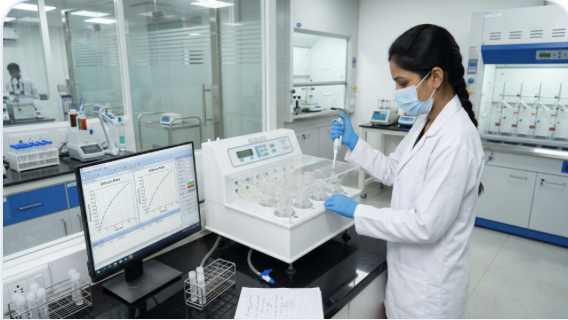
Testing against agreed monographs or specifications.
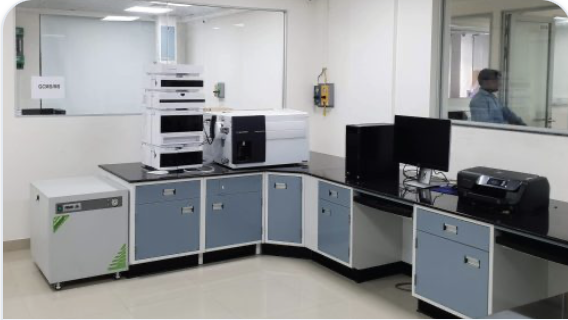
Release, stability and product-performance support.
Complete testing menu
Each panel explains the typical scope, information required and indicative timeline. The final method, acceptance criteria and sample quantity are confirmed after review.
Method development, identity, assay, composition and volatile analysis.
Analytical development establishes a practical method before formal validation or routine testing. The programme may include technique selection, column and solvent screening, selectivity optimisation and preliminary qualification.
Development identifies suitable operating conditions. Validation then evaluates relevant characteristics such as specificity, linearity, range, accuracy, precision, detection or quantitation limits, robustness and system suitability.
Chromatographic testing separates and quantifies components in drug substances and products. The method may be pharmacopoeial, client-supplied or developed for the project.
LC-MS combines chromatographic separation with mass detection. It is useful when the expected molecular mass is known and a suitable ionisation and detection approach can be established.
A deformulation project combines complementary techniques to understand active content, excipients and selected physical or performance characteristics. The scope is defined around the development or comparison question.
Volatile testing is selected according to the sample matrix and target compounds. Headspace introduction is commonly used for APIs, excipients and solid dosage forms.
Incoming material, development-batch and finished-product programmes.
The test panel is selected from the applicable monograph, client specification and known material risks. Full or selected testing can be agreed.
Excipient testing supports incoming release, supplier qualification and formulation development. The panel depends on the excipient's function and applicable specification.
A finished-product panel is built around the dosage form, specification and batch-release or development purpose.
The apparatus, medium, speed, sampling points and analysis method are selected from the applicable monograph or development protocol.
Stability work requires an approved protocol defining storage conditions, time points, test parameters, packaging configuration and acceptance criteria.
Photostability studies help determine whether light affects appearance, potency or degradation and whether protective packaging or labelling is needed.
The panel is selected according to the material grade, intended pharmaceutical use and applicable specification.
A comparison programme can assess consistency across vials, production lots, suppliers or development batches using a common set of methods.
Microbial quality, sterility, endotoxin and targeted safety assessment.
Microbial-limits testing assesses total aerobic microbial count, yeasts and moulds, and specified organisms relevant to the material or product.
Sterility testing is planned according to the product, container, available quantity and applicable method. Method suitability may be required before routine testing.
Endotoxin testing is commonly relevant to parenteral products, pharmaceutical water and other materials with an applicable endotoxin requirement.
Preservative-efficacy testing follows a defined challenge and sampling schedule to assess control of specified microorganisms over time.
The panel depends on whether the formulation is ethanol- or isopropanol-based and on the intended quality or registration requirement.
A targeted screen is designed around the contaminant of concern, available reference standards, expected concentration and sample matrix.
Investigation of impurities, thermal behaviour and solid-state properties.
An impurity programme is designed from the compound, synthesis route, formulation, stability risk and applicable limits.
Nitrosamine testing should follow a product-specific risk assessment. The method and reporting limit depend on the target compounds, maximum daily dose and sample matrix.
The element list is selected from the material, manufacturing route, catalysts, equipment contact and route of administration.
Talc may require screening for fibrous mineral contamination. The test approach and detection requirement are agreed from the material grade and applicable specification.
X-ray diffraction produces a material-specific pattern that can support phase identification, comparison of solid forms and assessment of crystalline versus amorphous content.
Solid-state characterisation combines complementary techniques to understand polymorphism, crystallinity, thermal events, volatiles and molecular identity.
Thermogravimetric analysis helps assess moisture, volatile residues, desolvation, decomposition and residual mass.
Differential scanning calorimetry supports investigation of melting behaviour, glass transition, polymorphism, purity and drug–excipient compatibility.
A Franz-cell study measures the rate and extent of drug release or permeation through a selected membrane into a receptor medium.
Particle-size distribution can affect flow, blending, dissolution, stability and product performance. The dispersion approach must suit the material.
Not sure which test to request?
We will help organise the requirement into a clear testing scope.
Discuss Your Requirement